User Guide Contents
Models
OpenEvidence offers a family of medical AI models, named for founders of modern medicine: Osler, Sackett, and Snow. Every model is held to the same standard of clinical accuracy. What varies is time: how long a model thinks, and how deep it searches.
Osler, Sackett, and Snow are available to all verified clinicians with unlimited usage, at no cost. Choose the right model for your task using the model selector in the OpenEvidence interface.
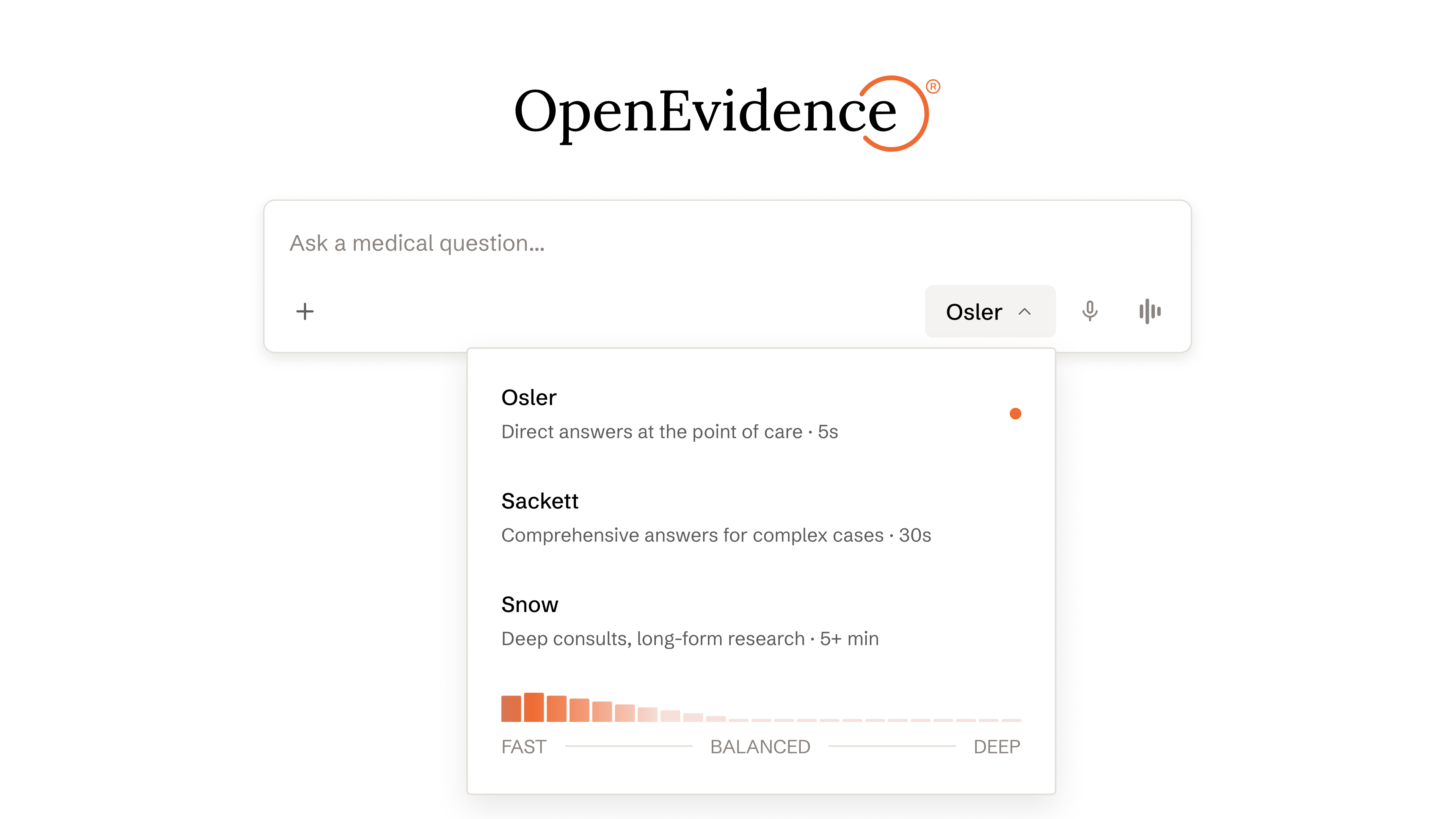
Osler
Direct answers in seconds. The default model.
Osler most closely resembles the OpenEvidence you already know. It prioritizes directness and speed, giving near-instant, citation-backed answers at the point of care. Use it for quick lookups between patients, such as a dose, a diagnostic criterion, or a first-line therapy.
It is named for Sir William Osler, who brought medical teaching to the bedside and was known, among other things, for his pithy aphorisms.
Sackett
More extensive and more interactive. Seconds to a minute.
Sackett trades some speed for a more comprehensive answer. Compared to Osler, it surveys the evidence more thoroughly, writes more extensive answers, and is more likely to ask you for clarification when a clinically significant detail is missing. Use it when the right answer depends on specifics that a one-line question does not include.
It is named for David Sackett, a founder of evidence-based medicine, who insisted that good answers start with a well-framed question and a careful appraisal of the evidence behind it.
Snow
A comprehensive, structured report. Five minutes or more.
Given a hard question, Snow runs a full investigation of the medical literature over several minutes, pursuing every relevant line of inquiry, before writing a comprehensive, structured report. It is built for the toughest cases: complex differentials, treatment planning under competing comorbidities, and questions where the literature itself is unsettled or you want an extensive deep dive.
Snow is the successor to Deep Consult. Questions you previously sent to Deep Consult should now go to Snow.
It is named for John Snow, an anesthesiologist by trade, who traced a London cholera outbreak to a single water pump through patient, systematic investigation, and in doing so helped found modern epidemiology.
Which model should I use?
Start with Osler. It answers most questions well and answers them immediately.
Choose Sackett when a question has enough nuance that you want a more thorough survey of the evidence, or a clarifying question before the model answers.
Choose Snow when a question is hard enough to warrant a comprehensive written report and you can wait several minutes for one.
Darwin
Darwin is OpenEvidence's most advanced model and, at the time of its release, the most advanced medical AI model in the world. It is available as a research preview, by application only, to institutional partners bringing their hardest cases, research collaborators, and academic researchers benchmarking the accuracy and safety of AI in clinical medicine. Apply for access at openevidence.com/research-api-access.
It is named for Charles Darwin, who gathered evidence for twenty years before he published, because he understood what his findings would mean. OpenEvidence is releasing the model that bears his name the same way.