User Guide Contents
Access Intelligence
Overview
Access Intelligence brings patient support programs and insurance paperwork alongside the clinical evidence. Ask about a drug’s cost or access, or about support for a diagnosis, and the answer includes a Cost & Coverage section with the programs that fit. Ask OpenEvidence to draft insurance paperwork, and it draws on manufacturer resources where they exist. It covers over 2,500 programs, and program information is updated daily. Access Intelligence is free for all clinicians.
Access Intelligence includes:
- Support Program Information in Answers to find programs and check eligibility
- Send to Patient TakeHome to give a patient everything they need to use a program
- Program Enrollment on OpenEvidence for enrollment forms pre-populated with your details
- Prior Authorization and Appeals Support for prior authorizations, letters of medical necessity, appeals, and medical equipment
Support Program Information in Answers
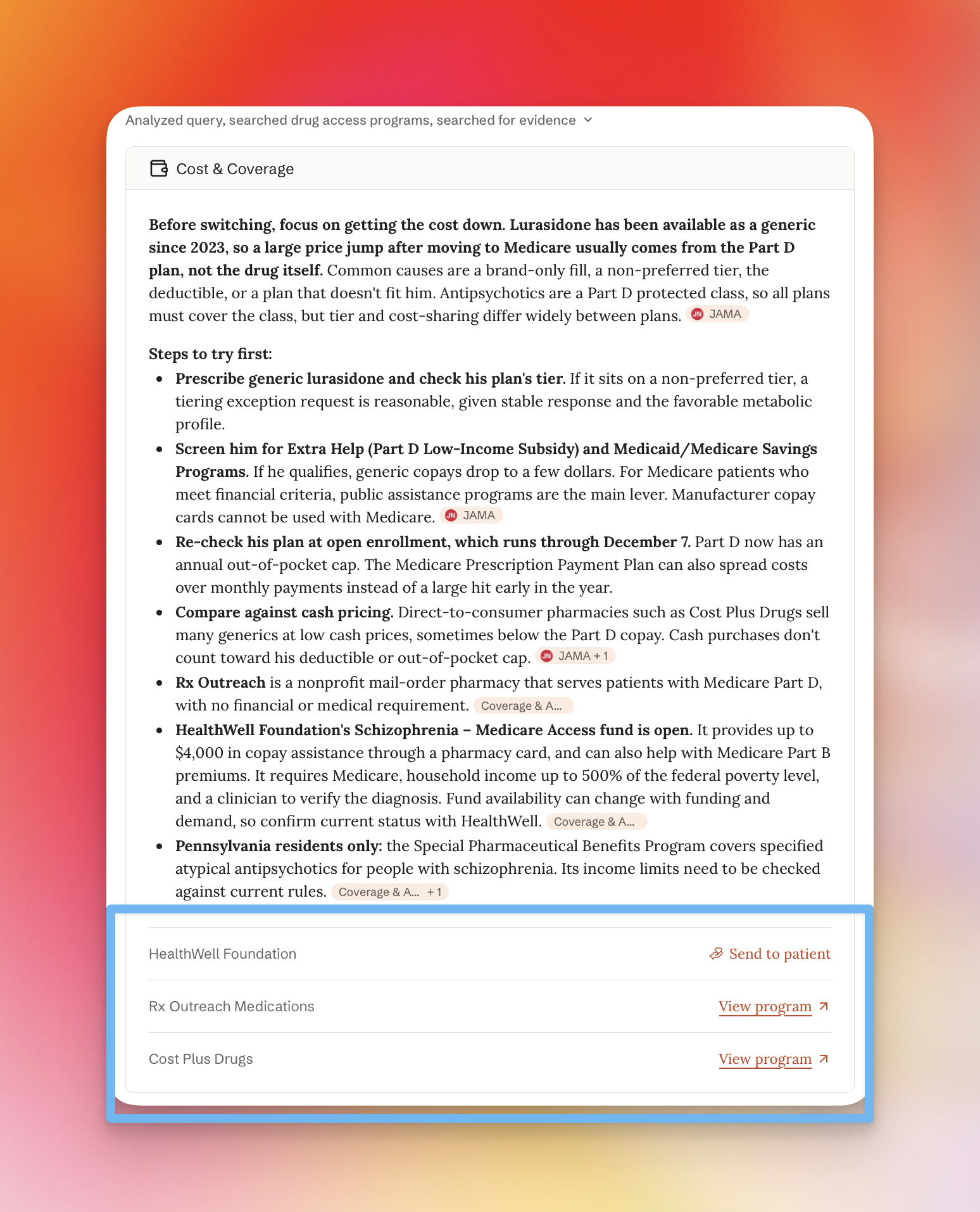
The Cost & Coverage section lists up to five programs. Each shows its name, a summary, its benefits and eligibility, and a citation. Programs that are not taking new applications show a status: Closed to new applications, Waitlist, Re-enrollment only, or Available by phone.
Programs include copay savings cards, discount offers, patient assistance programs that provide free medicine to patients below an income threshold, foundation funds that pay copays or premiums, free trial and quick-start offers, rebates, bridge supplies while coverage is decided, and manufacturer support hubs.
Each program has a button to act on it:
- Open application when the program has a web form or portal
- View application PDF when the program’s application is a PDF
- View program to open the program’s page
- Call when the program can only be reached by phone
- Send to Patient when the patient can enroll on their own
- Download prefilled application for supported patient assistance programs
Send to Patient TakeHome
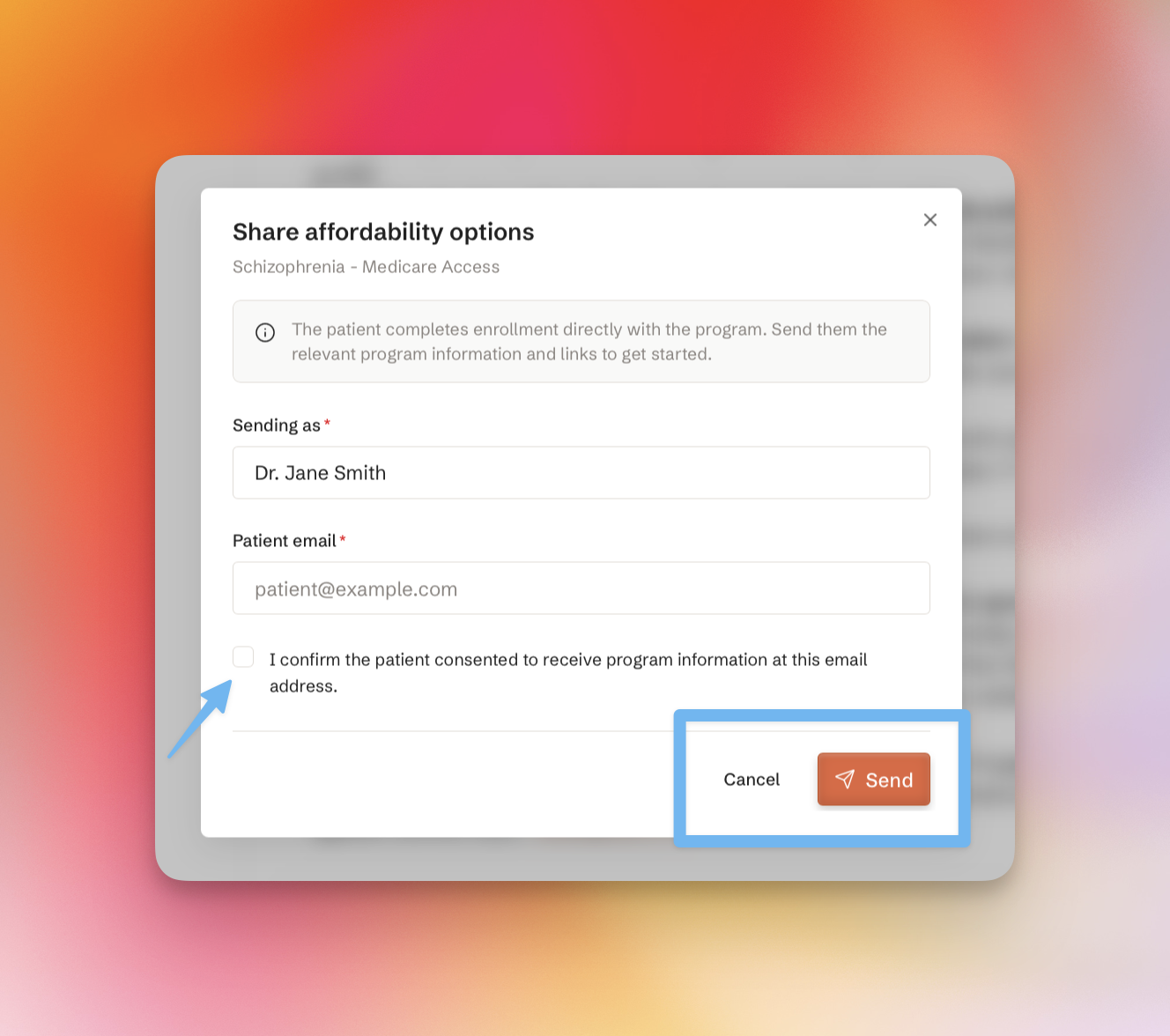
For programs a patient can complete on their own, such as copay cards, discount offers, and rebates, click Send to patient. Enter your patient’s email address and confirm your patient has consented to receive program information. Your patient receives the take-home page by email, with:
- The program’s name, drug, and summary, current as of when they open it
- The program’s sign-up or enrollment link
- The program’s phone number
- Pharmacy codes (BIN, PCN, group, member ID) to show at the pharmacy counter, where the program has them
- A form the patient can start, or the copay card itself, where the program has one
See Patient Take-Homes for more general information.
Program Enrollment on OpenEvidence
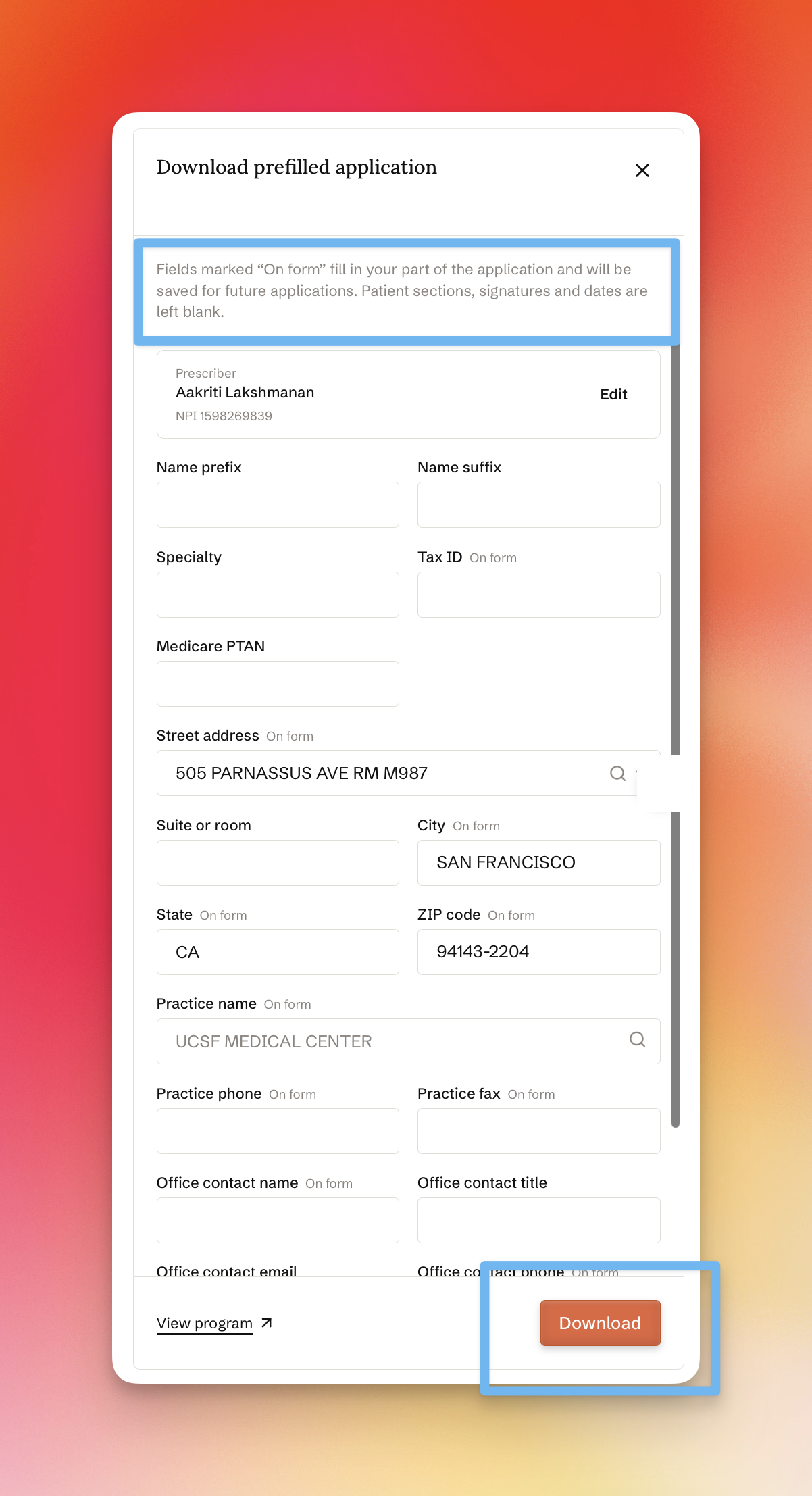
For supported patient assistance programs, support hubs, and bridge programs, click Download prefilled application to download the program’s application with your prescriber details filled in. The first time, a side panel opens where you enter your prescriber details, including your NPI, specialty, and practice address. OpenEvidence saves them for future applications. Patient fields, signatures, and dates stay blank. Review the form, complete the patient’s sections with them, and submit it to the program.
Prior Authorization and Appeals Support
Ask OpenEvidence to draft paperwork related to insurance coverage, for example:
- Prior authorizations
- Letters of medical necessity
- Step-therapy and denial appeals
- Medical equipment
For drugs with manufacturer resources, answers include the manufacturer’s coverage guides, prior authorization checklists, and templates for letters of medical necessity and appeals. Drafts draw on the manufacturer’s templates where available, use the right letter for an initial request or a denial, and flag what you still need to fill in.
Examples
Patient in his 60s with schizophrenia, well controlled on lurasidone, just moved from employer coverage to Medicare. He’s told me his monthly cost went up a lot and he’s already skipping doses. What can I do to help him stay on it, and if we need to switch, what’s a reasonable lower-cost option with a similar metabolic profile?
My patient has migraines but has failed all generics. What are some options for a cost conscious patient?